
COP30 will be remembered as the moment adaptation finally took centre stage. After years of warnings from scientists, practitioners and vulnerable countries, negotiators acknowledged an unavoidable reality: the world is now firmly on a trajectory beyond 1.5°C, and investment must increase toward adaptation at a scale never seen before. From new global adaptation indicators to finance targets and early-stage investment pipelines, the summit delivered progress - but also a clear message that current systems are nowhere near fit for purpose.
A Summit Defined by Adaptation - and by the Scale of the Challenge
COP30 delegates adopted a comprehensive set of global indicators under the Global Goal on Adaptation and agreed to significantly ramp up adaptation funding over the next decade. Yet the numbers tell their own story. Current flows remain drastically short of the estimated hundreds of billions of dollars needed annually to protect communities, economies and ecosystems from escalating climate impacts. The political shift, however, was palpable: adaptation is no longer the quiet sibling of mitigation. It is now a central organising principle of climate diplomacy. But structural transformation - policy, capital, markets, incentives - is still missing.
An Actionable Vision For Closing The Adaptation Gap
During the pre-COP week, Morphosis unveiled the Adaptation Economy Policy Framework at a Bloomberg hosted event in Sao Paulo, the first comprehensive approach to how governments, investors, solution providers and citizens can build an economic architecture capable of financing adaptation at scale.
The framework argues that adaptation must evolve from sporadic development assistance into a full-fledged economic system - complete with investible assets, clear market signals, targeted public-private mechanisms, and institutions that can deliver adaptation as a measurable outcome. Shaping what adaptation can become - not just what it currently is.
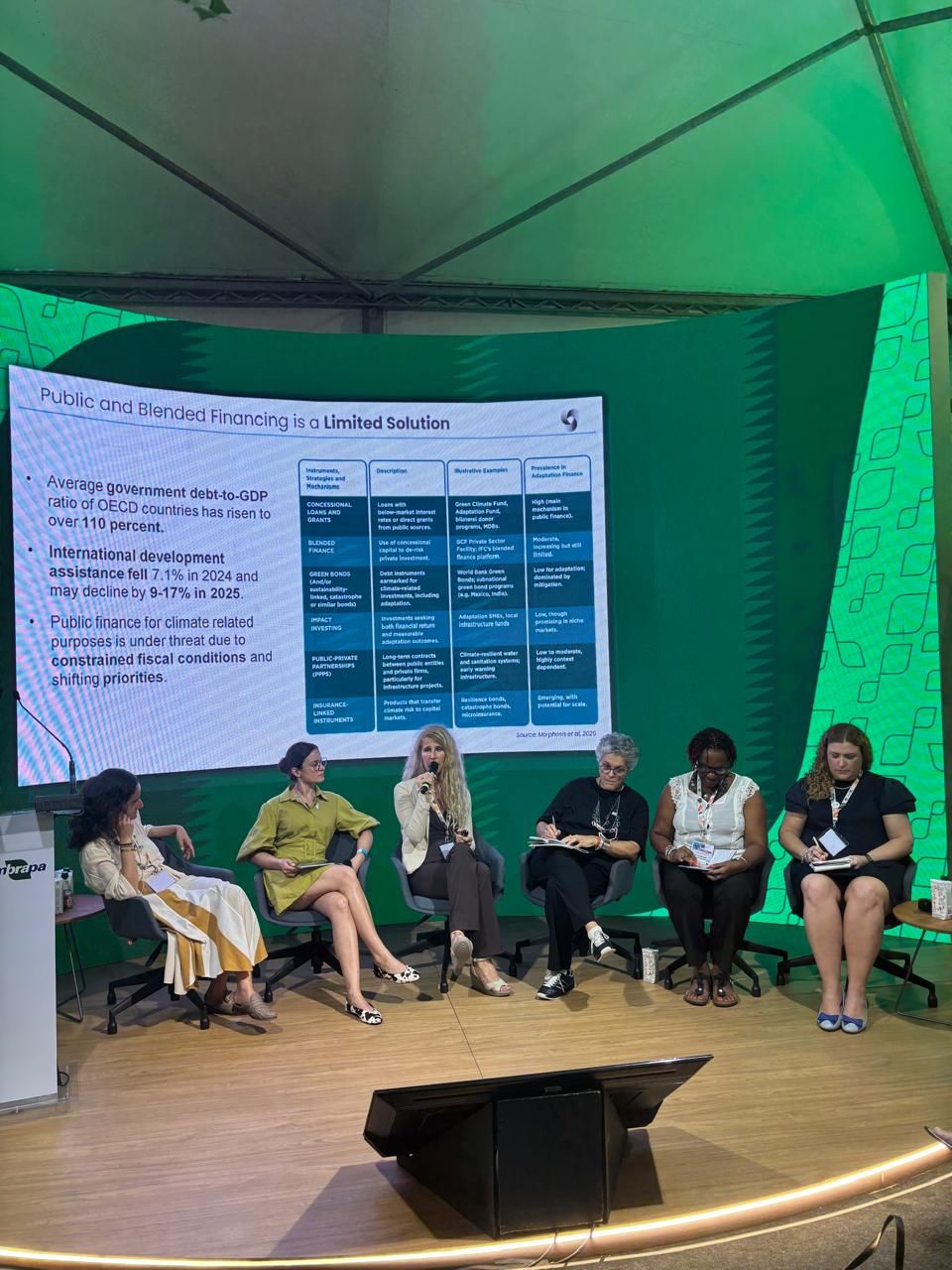
At Embrapa’s AgriZone in Belém, Morphosis was pleased to continue the discussion with an invitation from the COP presidency to meet with women leaders working in adaptation from agriculture, finance, research and civil society to explore how the new adaptation economy approach can help the world move forward towards its goals. The message was clear: without leadership and equitable governance, no adaptation economy will succeed.
Why the Adaptation Economy Matters Now
COP30 made visible what many have long understood: Traditional development finance cannot carry the weight of the climate era. Adaptation cannot remain a grant-dependent, slow-moving, under-capitalised domain. It must become market-ready, investment-aligned, policy-coherent, and locally grounded – moving from the margins of climate debate into the mainstream of economic planning. As COP30 closes, Morphosis is clear:The world doesn’t just need more adaptation funding - it needs an adaptation economy.
%201.svg)