

For decades, the global climate conversation has treated buildings and construction primarily through the defensive lens of mitigation—a race to reduce embodied carbon, swap out concrete mixtures, and improve energy efficiency. These are notable efforts, but insufficient in a rapidly warming world. When the conversation does occasionally pivot toward climate adaptation, it routinely stumbles into a classic category error. Policymakers and trade bodies treat a building as an isolated, rigid asset designed to withstand a specific storm or thermal threshold.
This narrow framing misses the grander macroeconomic shift unfolding around us. Buildings and construction are not just carbon-intensive sectors in need of fortification; they are the primary frontier of the emerging adaptation economy—the vast, interconnected set of activities, policies, and institutions delivering the goods, services, and systems required for inclusive prosperity in a climate-impacted world.
To unlock the massive commercial and social potential of this space, we must radically shift our perspective. A building is not a static piece of physical property. It is a dynamic architecture of flows—air, water, energy, data, and materials—embedded within a wider, living landscape.
The Holistic Built Landscape
When we look at individual buildings in isolation, we ignore the systemic interventions that actually dictate their survival and economic viability. If a building code only mandates thicker insulation for a skyscraper but ignores the surrounding asphalt that exacerbates the urban heat island effect, it has failed. True resilience requires shifting our focus from the individual structure to the broader built landscape.
This landscape approach integrates traditional grey infrastructure with nature-based solutions, such as urban tree canopies, bioswales, and porous surfaces. Consider China’s "Sponge City" initiative. By redesigning entire urban landscapes to absorb, store, and purify rainwater through green spaces and wetlands, participating cities do not just protect individual basements from flooding; they systematically mitigate regional water scarcity, enhance baseline environmental quality, and lower localised temperatures.
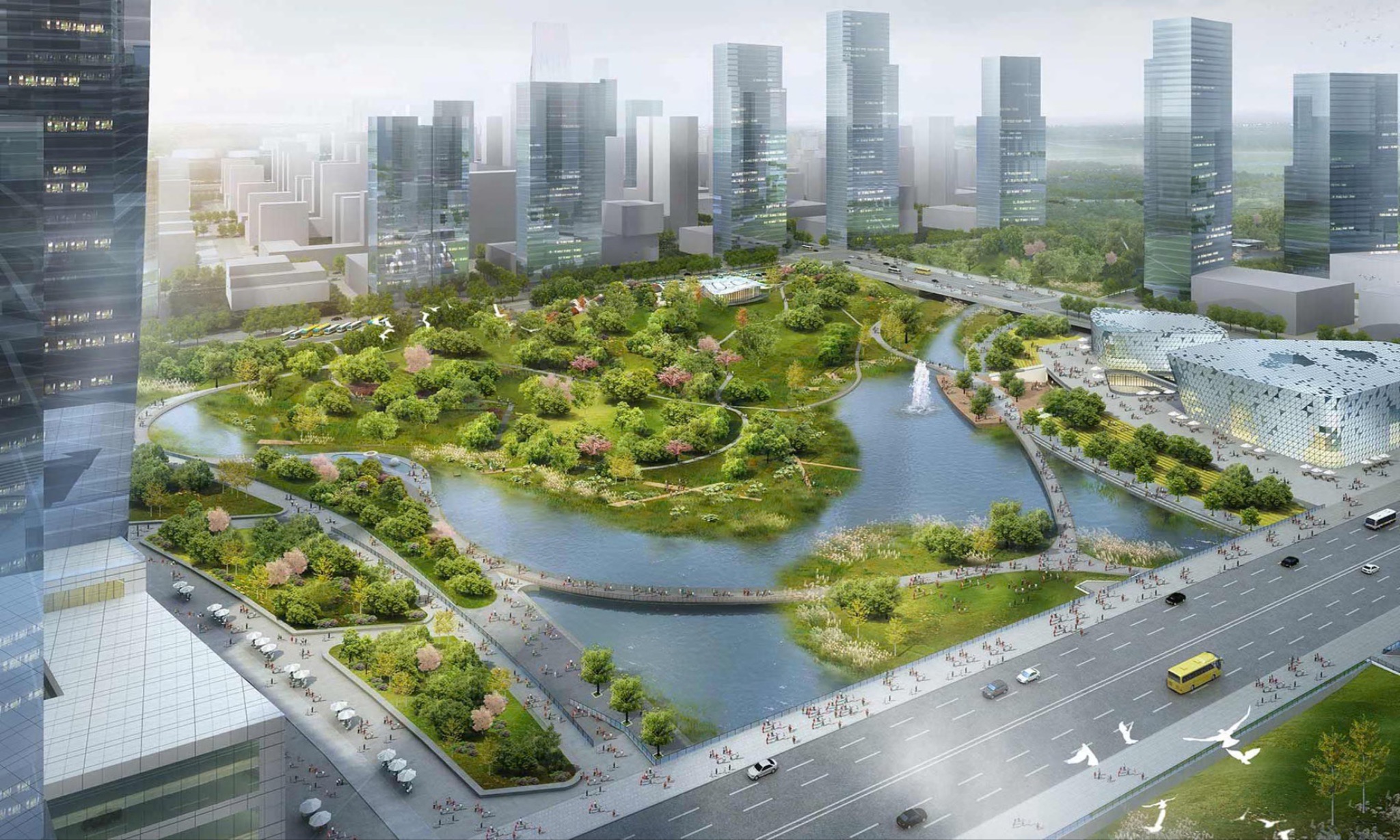
A render of Xinyuexie Park, which is designed to preserve and improve how the city copes with stormwater.
Photograph: Obermeyer. Source: The Guardian
When built environments are treated as integrated ecosystems, nature-based cooling and watershed management become active, market-led adaptation mechanisms. In addition, because these landscape-scale interventions are inherently labour-intensive, they offer a "double dividend": the opportunity to generate immediate local employment while securing long-term economic competitiveness.
Managing the Architecture of Flows
Once we look inside the structure, the static asset model must give way to a sophisticated management of metabolic flows. In a world heading past 1.5°C of warming, legacy centralised utilities are rapidly transforming from premium assets into compounding liabilities. Expanding traditional, water-intensive centralised sewer networks into increasingly water-stressed regions introduces profound long-term economic risk.
Our work on the adaptation economy approaches this challenge by articulating the need for robust markets that can deliver decentralised, circular solutions. In the architecture of flows, a building becomes an independent node capable of managing its own inputs and outputs. Next-generation, non-sewered sanitation units, for instance, operate with little to no water, remaining fully functional even when the city taps run dry. By recovering organic nutrients locally, they transform a waste liability into a strategic asset that stabilises local ecosystems and creates entirely new industrial verticals.
When we prioritise decentralised home cooling, localised water distillation, and the on-site recovery of materials, we are effectively shortening our supply lines and insulating our communities from climate-disrupted global supply chains. Reliability itself becomes the ultimate premium asset. Under extreme climate or geopolitical stress, distributed, circular systems can outperform rigid, centralised ones—not because they are cheaper to build, but because they possess the systemic flexibility to keep functioning.
The Critical Role of Global Trade and Standards
Given government budget constraints, private investment is critical for the transition. Yet the picture is mixed. On one hand, global private investors are ready to deploy capital, with sovereign wealth funds like Singapore's GIC identifying adaptation as an "inevitable investment" and projecting a growth opportunity from US$1 trillion today to US$4 trillion by 2050, much of which is destined for investments in the built environment. On the other hand, negative market sentiments persist because today's ad hoc regulatory environments too rarely reward adaptation solution businesses supplying the needed materials and services. Major barriers to scaling this vision are neither a lack of technology nor investor appetite, but often outdated and globally fragmented standards.
Reconstruction after climate disasters too often defaults to the same building codes that made disaster possible, not the ones needed to avoid the next one. And although better codes are being devised and deployed, they often remain contained within borders. When future-proofed technical standards and building codes diverge unnecessarily across every border and municipality, solutions remain prohibitively expensive boutique niches, often entirely out of reach for low- and middle-income households.
This is where international organisations like the World Trade Organization (WTO) have a critical role to play. By driving the harmonisation of technical regulations and resilience standards, trade frameworks can systematically reduce market fragmentation. Standard-setting acts as the vital regulatory software required to turn latent need into investable demand. It provides a common language that allows an innovator developing a specialised heat-resistant material or a modular water recycling unit to scale production across multiple jurisdictions without facing arbitrary regulatory barriers. This can sharply drive down consumer costs through economies of scale.
Forward-looking governments can also use public procurement standards as a direct macroeconomic lever. By mandating that public infrastructure projects incorporate forward-looking standards, countries can actively de-risk early-stage adaptation markets and anchor private sector investment in the built environment of tomorrow.
The Leapfrogging Opportunity
While advanced economies struggle with the immense sunk costs and rigid vested interests tied to their outdated legacy infrastructure, developing and emerging economies possess a distinct, structural advantage. They can leapfrog the centralised, now fragile systems of the 20th century entirely. Just as M-Pesa allowed nations to skip the landline-and-bank-branch era to go straight to mobile finance, and the rollout of off-grid solar is rapidly outpacing grid-based energy networks—often because centralised state utilities were unable to reach the vast majority of the population—climate-vulnerable nations can construct their built landscapes for tomorrow's climate from the ground up.
This does not require vastly superior resources; rather, it demands the strategic alignment of trade policy, technical regulations, and market design. The question before international trade bodies, policymakers, and investors is no longer whether climate disruption will reshape our markets. The question is whether we can evolve our regulatory and trade frameworks quickly enough to stop viewing buildings as static objects to be fortified, and start managing them as the dynamic, investable foundations of tomorrow’s global economy.
To effectively navigate this transition, diagnostics and measurement are vital. Both our qualitative Adaptation Economy Framework—which maps out the essential policy domains required to lower barriers and attract capital—and our newly released Adaptation Economy Index—which quantifies these enabling structural and market conditions across 72 countries—serve as practical tools. Together, they offer a helpful roadmap for policymakers, investors, and solution providers to track progress, align standards, and turn adaptation into a powerful driver of global economic value.
Discover the framework, explore the full 72-country dataset, and read the latest briefing at morphosis.solutions/aei
%201.svg)