
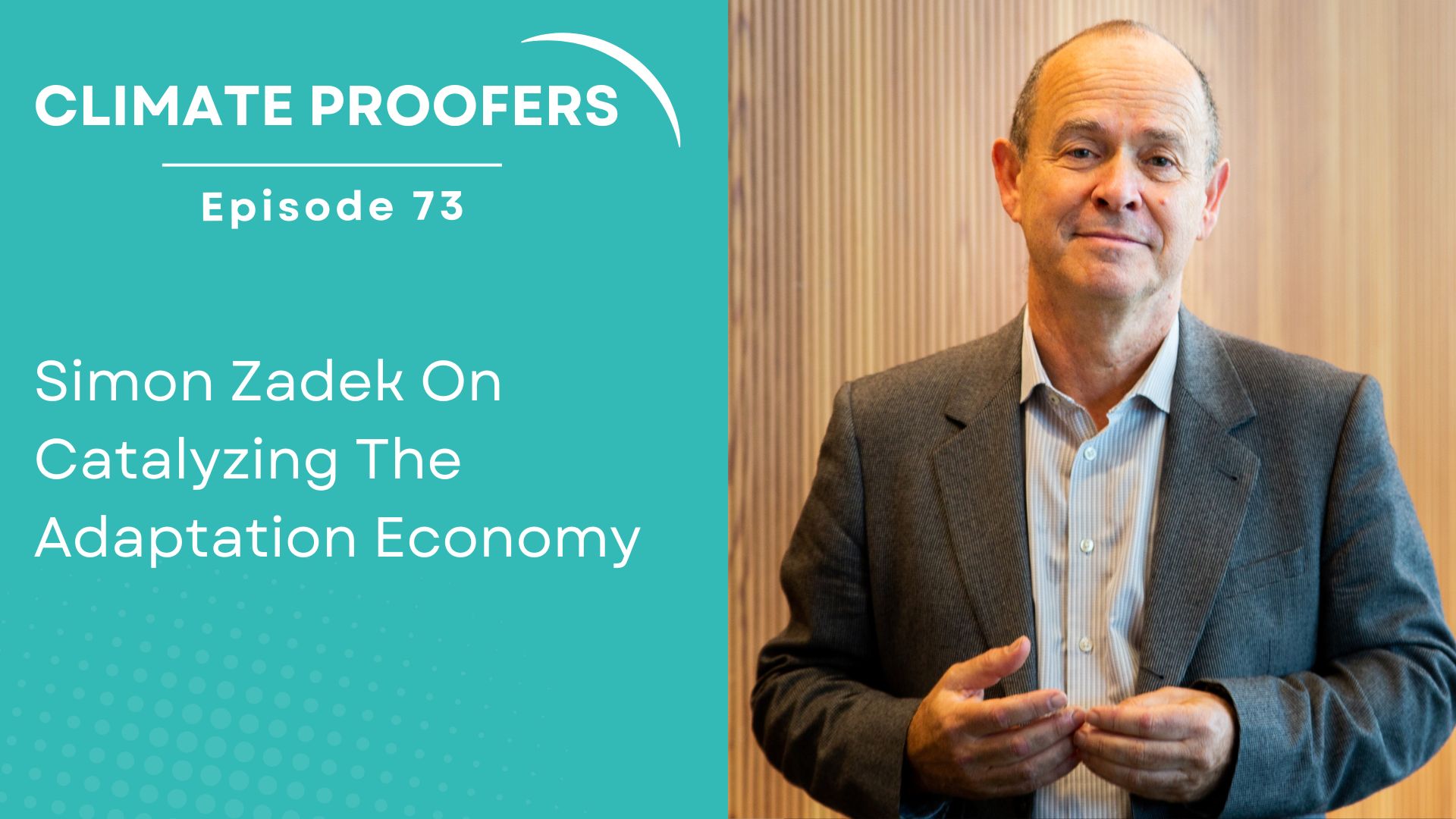
Morphosis’ Simon Zadek joined the Climate Proof podcast to discuss what it will take to build an adaptation economy fit for a world beyond 1.5°C.
In the episode, “Simon Zadek On Catalyzing The Adaptation Economy,” Simon reflects on a career that has spanned early work on labour rights and social auditing, to shaping green finance and nature-based investment - including roles with Ben & Jerry’s, the UN Secretary-General, and China’s green finance strategy. That journey led to a critical conclusion: climate change is advancing faster than policy and markets can mitigate, and economies now need to adapt at scale. Listen to the full podcast here.
Louis Woodall: Hi Simon, where are you calling from today and what do you do?
Simon Zadek: Hi Louis, I am calling from Geneva in Switzerland and I am the co-founder and co-managing partner of Morphosis.
Louis Woodall: Thanks for joining us today, Simon. I've got to know you and the Morphosis team a little over the last few months, and you're one of this interesting grouip of companies springing up in the climate adaptation space. But before we get into Morphosis and before we get into this new report you've launched, can you talk a little bit about yourself, your career today, and why at this juncture you and the Morphosis team are focusing on climate adaptation?
Simon Zadek: Sure, happy to. I'm not even sure if I can describe my journey as a career rather than just a series of faltering steps, but I started working on sustainability and business issues as early as the late 1980s. I've moved through various aspects of that agenda, spent almost 10 years working on workers' rights and labor rights as the sweatshop campaigns began to emerge, through to a lot of focus on the emerging—what at that time was called—social auditing profession. I was the first social auditor of the Body Shop, Ben & Jerry's, and many of the companies that began the journey that has now landed with the ISSB and other international reporting standards.
Then in the early aughts, I pivoted towards finance and I've spent the last 10 to 15 years working on how private finance and the financial system as a whole can take different aspects of sustainability into account. I spent quite a lot of time living in China working with the Chinese financial regulators, running their green finance workstream under their G20 presidency, and then ran for the UN a large-scale inquiry on financial markets and sustainable development. I worked for a couple of years for the UN Secretary-General working on the same topic, and founded Nature Finance, a Swiss-based NGO, in 2019. For five years I ran that and contributed to what has been a hockey-stick growth of work in that field, and gradually just felt increasingly that as we were clearly heading beyond 1.5 and probably north of 2 degrees within a painfully short period of time, we needed to bring together these different social, climate, and other agendas into an adaptation-focused approach to how we're actually going to live in that world we're facing. So, I left Nature Finance after five years of successfully building it and co-founded Morphosis.
Louis Woodall: So you've been involved in various different aspects of the sustainability fight, let's say, from the Rio principles and sweatshops through to Nature Finance. Are you saying that your pivot to adaptation is because of your realization of the trajectory of the science and the trajectory of our social policies towards decarbonization not being enough to get us below 2 degrees? Is this a scientific reason that you're looking at adaptation or are there other factors at play?
Simon Zadek: Just before COP28, when I was still at Nature Finance, we published a piece that I authored called "Time to Plan for a World Beyond 1.5 Degrees". The essence of the message, as the title implies, is that we needed to bite the bullet given the science, to your first point, but also recognize that the extent of change coming requires long-term planning and phase-shift levels of innovation. If at that time we had about 130 to 140 million refugees, the UN IOM (the migration organization) predicts a billion plus within 20 years. It wasn't just about accommodating more people in trying to deal with a refugee crisis; it was about rethinking and reframing a world where perhaps a fifth or a sixth of the global population was permanently on the move. The same goes for food, water, and other topics.
To your point, it is partly the science but also partly a kind of new generation of climate denialism. This is not so much the one we've been accustomed to in the past where climate change doesn't exist, but actually much of the climate community itself and many progressive actors—whether in business, policy, or civil society—are not willing to say, "This is where we're heading, get with the plan, and create one to act". I felt that was a large-scale behavioral problem, an identity problem within the climate community, a political problem as we could see more broadly, and a market problem—which is, of course, where I've placed most of my assets.
Louis Woodall: That's a really interesting point about a new phase of climate denialism, and I think that has impelled a number of projects by think tanks, market participants, and climate diplomats to pivot to adaptation. Let's turn to Morphosis: what's your elevator pitch for the organization and what gap in the market would you say you're filling?
Simon Zadek: The elevator pitch is that we are a hybrid adaptation solutions business. What does that mean? It means that, on the one hand, we have a private investment window—effectively a private equity shop—where we're looking to invest in businesses at their Series A or Series B stage. These are companies that will be able to scale in delivering adaptation solutions in a world well north of 1.5 degrees.
Alongside that investment window, we operate what we think of as a merchant banking window. How do we identify and work with businesses that will be profitable in the future but that have to cross a different "valley of death"—a period of time where markets are simply not rewarding adaptation solution businesses in the way they need to be? We assist with their strategy, their product mix, and their market entry to help those growth businesses bridge that short-to-medium-term period where adaptation markets are not yet present or functioning effectively. That's the second part of our business.
The third part of our business is on the knowledge, policy, and demand side. How do we help governments understand the policy frameworks and levers that can create markets that reward those adaptation solution businesses sufficiently? This attracts the vanilla commercial capital that drives them into a virtuous cycle of scaling, innovating, bringing down costs, and making their products widely affordable. What is it that we need to help those governments do? There is a knowledge-policy solution side to the business that one might think of as the demand side of the adaptation solution space, whereas our merchant banking and investment work represents the supply side of the adaptation solution space.
Louis Woodall: That's interesting, so you're having an effect on both sides of the dynamic.
Simon Zadek: Yes, I think that's right, and to some extent, it is reflected by our top leadership team. My co-founder, Niall Murphy, is a serial technology entrepreneur—a build-and-operate guy who has scaled multiple technology companies, raised capital to make them work, and exited them. Conversely, I've tended to work more on the policy and market-shaping side. Still very market-oriented, but working with policy and broader public institutions in order to shape markets that make labor standards work or ensure carbon is taken into account. We bring in a wider team of actors that are able to cross over from the demand side and market-shaping side through to supporting business strategies and the investment side.
Louis Woodall: I want to get onto the knowledge side of the business in a moment, but just to drill down on the investment window concept you mentioned. Are you attracting limited partners from institutional investors, are you managing money you've already secured from your own general partners, who are you trying to attract to invest in adaptation solutions, and where is the money coming from?
Simon Zadek: It would be right to say that we are trundling down the runway as a startup ourselves, having come into existence in the early part of this year. Our approach is not, in the first instance, to set up a massive fund but to identify a pipeline of individual businesses that we work with and then take to market through Special Purpose Vehicles (SPVs). This allows investors a direct line of sight and decision-making over individual businesses rather than contributing to general funds where they have relatively little visibility.
Similarly, those investors—particularly in the early stage where we are talking Series A checks between $1 million and $5 to $10 million USD—will tend to be family offices or high-net-worth individuals. It remains an open question as to whether we will open a traditional fund structure in our second stage of growth to attract larger-scale funding from institutional investors.
Because we're not simply a private equity shop but have this cross-cutting set of interlocking business functions, Morphosis itself is investable. We are in the process of raising equity into Morphosis, which gives family offices and high-net-worth players an opportunity to put a stake in the ground in the growing adaptation economy. This allows them to earn returns from the work we do as Morphosis and get a line of sight on the broader emergence of this area, enabling them to look at their own portfolios and deploy assets more broadly in the adaptation investment space as it matures.
Louis Woodall: It's an interesting and innovative structure, but I think it's one that works really well when you have an emergent market like climate adaptation. I am familiar with other venture studios like Tailwind Futures; they started out by providing the intellectual underpinnings for venture investment in climate adaptation, issued a lot of intellectual capital, and are now building their fund off of it. When you have an early-stage market like this, it is very helpful to have organizations that foster and educate investors while creating the policy environment in which investments can flourish.
Simon Zadek: I think that's right. I don't think there's anything entirely unique about the structure of our approach, but it allows growth in diverse ways. If you're a pure-play private equity fund, the way you grow is just getting a bigger balance sheet, raising more capital, and deploying it. That's one way to be successful and profitable, but it's not our preferred approach. We think our model allows a Morphosis ecosystem to emerge where many partners, often with their own balance sheets, can become part of a co-investment strategy and a co-development strategy on the knowledge side. We are hoping our overall growth structure allows for a more distributed approach. For example, distributed by having relationships with funds in sub-Saharan Africa, or distributed in terms of having relationships with other knowledge partners that utilize our IP developed as part of our insights platform. I don't think this is only for the early stage of our growth before becoming a vanilla balance sheet; this offers ways of growing and being successful financially in a more chaotic, networked world.
Louis Woodall: Yes, the fun of being a startup, right? All the potential and all the future paths you could go down. I think it's important to have an initial vision, which you have, and see where it takes you.
Okay, I'd like to turn to your debut report at Morphosis, The Rise of the Adaptation Economy. This is a combination of a review of adaptation finance, country-based research with deep dives on Brazil and China, a technical paper on the adaptation economy, and a bundle of guidance and tools that make up what you're calling the Adaptation Economy Policy Framework. It was released the other day at COP, and I'd like to start by asking what you're hoping to achieve with this publication and what audience you are trying to reach?
Simon Zadek: Thanks very much, Louis. If I can start by analogy: today we have an almost $2 trillion a year investment market in renewables and clean tech from an almost standing start a decade or so ago, and it's worth remembering how we got here. We often say it's all due to the dramatic fall in the cost of solar and wind, and clearly those technology cost curves are an important part of the story. But the reality is that the beginning was quite different. The beginning was that Germany created the demand architecture that allowed China to scale. In the first instance, it was an energy and ecological strategy linked to German culture with a bit of industrial policy thrown in, and then it became an industrial policy for China. The market for renewables was largely created by policies as well as technology.
Then the next thing happened: as renewables needed more private investment across the world, the policy framework for enabling that to happen began to be standardized into a relatively small number of levers—feed-in tariffs, offtake agreements, and capital market instruments. Today, to exaggerate slightly, there's a turnkey policy package that one would recognize in Sudan and Switzerland as being broadly the same.
Now let's turn back to adaptation. That standardized policy playbook doesn't exist. The answer in the first instance is that adaptation is more heterogeneous and context-specific. Solar panels in Sudan look the same as solar panels in Switzerland, making it easier to standardize the policy framework. While that's true, we are beginning to see standardized verticals across different parts of the adaptation agenda, like common approaches to water or food security. How will financial regulation shape the nexus between private investment and adaptation solutions? How will trade policy, investment policy, R&D strategies, and national innovation plans intersect? These cross-cutting or transversal aspects of policy must be standardized to enable roadmaps to be developed, to understand which governments are creating markets, and ultimately to help investors decide where to deploy their assets.
The thinking behind the work is: how can we collectively move quickly toward a standardized policy framework for shaping adaptation economies? This can make adaptation solutions more profitable, attract private capital, allow innovation to scale, bring down costs, and enable availability and affordability. Technology innovation and entrepreneurial energy are terribly important, but most important markets in the world are shaped by policies, and we haven't got our heads around how to do that for adaptation. This piece is a contribution to that agenda at a moment where there's more money looking to invest in adaptation solutions, but the concern is that those markets are not yet delivering adequate financial returns.
Louis Woodall: The core thesis is very clear: we need enabling policies to foster the market for adaptation solutions. Can you provide a few examples of what these policies could look like? On the adaptation side of the equation, what sort of policies do you think could be real catalysts for investment and innovation?
Simon Zadek: Think of some of the things you've been writing in Climate Proof. There's interesting work going on right now among central banks and financial regulators who have historically focused on the carbon side of the story through the Network for Greening the Financial System. They are now beginning to move on the adaptation side too. UK regulators and the Central Bank are looking at what levers they have—capital weighting requirements, bond purchasing, refinancing—in ways that can make those investments more profitable. Adaptation solutions are likely to be less risky over time, and they should be duly rewarded in terms of capital weighting as the world heats up. This is spotty at the moment, but it's a great example of a transversal tool—financial regulation—supporting the growth of an adaptation economy across multiple sectors like water, food, and buildings.
The second example is that many adaptation solution businesses are not profitable because climate risk is not being priced into the markets in which they are operating. This is happening at the consumer end, through the supply chain, and at the investor end. We've seen many initiatives over the past 5 to 10 years seeking to push climate risk pricing into markets, either through a finance supply-side push or by imposing obligations on the broader business community. Notwithstanding the pushback we see in the US, some important developments will begin to drive that risk pricing into markets via statutory requirements defined by the ISSB and others. This will advantage adaptation solution businesses because of their inherent resilience and the growing desirability of their products, like low-energy air conditioning.
Think about R&D. Find me a country that has an R&D strategy where adaptation is truly integrated into the allocation of research funds and technology institutions. You may see interesting strategies emerging in the bioeconomy, but if you ask if there is a transversal lens being placed on public research funds in relation to adaptation, the answer is not at all. I can't think of a single country where that's happening. Those are the cross-cutting examples I would give alongside the verticals, such as incentivizing wastewater and desalination technologies that don't have severe polluting outlets through updated environmental standards.
Louis Woodall: I'm with you on the point that policies can trigger cascading changes in how markets price climate risk and how they behave. But I do wonder whether policy also moves too slowly. A number of pure-play investors I speak to think, "Look, policy is moving too slowly. What actually drives investment and activity now is businesses faced with floods, fires, and storms; they need to protect their assets and make their supply chains resilient. They're reacting to very specific needs rather than waiting for cross-cutting policies." What do you say to those who think market signals, rather than policy, are going to drive things?
Simon Zadek: Well, we wouldn't be having this conversation if there weren't a set of standards governing the digital signals running between you and me right now. Some emerged through technology or industry associations, but a lot emerged through policy development—the internet itself was initially funded by the US military. If we look at many of the highly valued tech businesses in the world today, whether on the West Coast of the US or in China, they have benefited enormously from policy measures, government-funded technologies, and standards advanced for the competitive advantage of national champions.
What is going to deliver climate-proof food security for low- and middle-income households in a 2.5-degree world? It's probably going to be the result of scaled technology, whether vertical farming or the next generation of lab-grown protein, underpinned by China's industrial strategy, not just organic market adjustments in the US or Europe. Governments play a critical role along the way.
If we look at Europe, it acts primarily as a standards organization; China operates via a policy-driven industrial strategy; and the US is more market-based with distributed industrial subsidies. These are very different policy environments. How does a country like Brazil maintain the power of its agribusiness economy in the context of climate change? Is that a pure-play business response, or are there broader policy measures required? The Brazilian business community certainly thinks policy is necessary. If you're an investor deciding whether to take an insect protein company to Kenya, Uganda, or Peru, your asset-level investment decisions will depend heavily on the availability of capital and the local regulatory environment regarding the product. There is a disconnect between speed and need, but looking at a slow Brussels process as the only case in point is unfortunate.
Louis Woodall: You've laid out this Adaptation Economy Framework. Can you tell us why you think it's needed, how it could be implemented, and how it differs from other efforts, like the OECD’s climate adaptation investment framework released last year?
Simon Zadek: At each stage of my journey, I've been fortunate to be at the hockey-stick moment of the topic—whether it was labor standards, carbon, financial regulation, nature, or now adaptation. What happens at those moments is a blossoming of innovation, a surge of experimentation, a mass of duplication, and intense competition. You come out at the other end with a convergence of approaches that raise the overall game. Competition, duplication, and personality fights on LinkedIn are just par for the course on the innovation curve. One has to focus on the core of what we are trying to achieve.
Our focus is on the policy frameworks that shape markets to attract private investment into undercapitalized, underscaled adaptation solutions and assets. If I compare it to the OECD, World Bank, or IFC frameworks, those investment frameworks are helpful, but they look exclusively through a finance supply-side lens. You will not find anything in those documents about R&D strategy, trade, or investment policies because that's not their focus.
The risk of looking exclusively through a finance supply-side lens is that because markets are not working, you always end up with a blended finance solution—which is effectively a subsidized solution by another name. Because the company isn't profitable enough, private capital won't flow, so tax dollars have to bridge the gap. I have no principled objection to subsidies, but if you look at the state of public finances, nobody believes that scaling public finance into commercial capital is a viable route. International development assistance fell by over 7% recently, and debt-to-GDP ratios of OECD countries have almost doubled over the past 10 years. This is a fiscal crisis across the board. We cannot solve this problem solely through a blended finance model; we need a whole-economy model, which is what every normal government does when thinking about economic strategy, industrial strategy, and trade agreements. Adaptation must not become a labeled vertical alongside the main game; it needs to be integrated into those core activities.
National Adaptation Plans (NAPs) are meant to be what I just描述, but they aren't in practice. Even the recent French National Adaptation Plan headlines that they are planning for a world of 4 degrees increase by the end of the century—an extraordinary thing for the French government to say. But if you read that voluminous document, you will find almost nothing about how to attract private capital into these adaptation solutions. They don't have a market game plan. Conversely, look at Brazil's sophisticated new industrial strategy shepherded by the Ministry of Finance; it has many environmental aspects, but it is not framed by a 2-to-2.5-degree world, so there is no actual adaptation play in it. The solution is to think early on about how we can standardize these policy plays across different contexts and measure progress as a result.
Louis Woodall: Yes, you've touched on another major tension in the adaptation debate: should it be siloed as its own stand-alone topic to make it easier to create investment taxonomies, or should it be integrated throughout our entire policy effort on climate? I understand both sides—the need to cross-cut and the need to focus in to create a strong investment thesis.
I want to finish by asking what you hope to achieve off the springboard of this report, and what your hopes are for Morphosis over the next 6 to 12 months?
Simon Zadek: We are launching these reports amidst a blizzard of other papers, so it has to be practical. It would be a big step forward if a few wealthy, middle-income, and lower-income countries began to utilize this whole-economy lens to inform their adaptation and industrial strategy roadmaps going forward.
We believe strongly that these frameworks need to be measurable and comparable, so we are already engaged in turning the framework into an index. Initially, this index will operate at the sovereign level, measuring progress made by governments in implementing policies that create adaptation markets. We will put out an initial version using existing, standardized text-based data sets analyzed via an AI engine. Over the course of the year, it will become an operational tool that can come down to a subnational, city, and ultimately asset level. We are in discussions with data providers to the financial community to see how we might bring this down to asset-level analysis, because resilience doesn't figure strongly enough in how we price public equities today. There needs to be a golden thread connecting the macro analysis down to the micro analysis.
For Morphosis in a year's time, if we are successful, I would modestly say we have survived—which is always a good starting point. Our private investment side will be evolving, and we will have a portfolio of businesses that we are working with across both our investment and merchant banking tracks. The knowledge side will translate from pure research into advisory services, generating the resources we need to function effectively as an integrated business.
If we are truly successful, we will have helped create an ecosystem of actors working with similar tools and instruments. We are not alone in this space—early movers like Gary and Lightsmith have done great work building coalitions—but our particular focus gives us a basis to contribute to forming profitable alliances.
Rooms that until now have had 20 or 30 people talking about adaptation are going to be five times the size and sold out. There is going to be a huge surge in actors entering this space. Governments in the Global South, particularly in sub-Saharan Africa, are increasingly going to insist on a much greater focus on the adaptation agenda. The context in a year's time will be a lot more intense, and we hope Morphosis can make a meaningful contribution to the adaptation economy.
Louis Woodall: Your thesis of a hockey-stick moment shines through there, as sparsely populated rooms are likely to become blockbuster events. I'm excited Morphosis is in this space, and I encourage my listeners to read the report and accompanying paper via the link in the show notes. Simon, thanks so much for your time and have a great rest of your day.
Simon Zadek: Louis, thanks very much indeed, and look forward to more.
Louis Woodall: Climate Proofers is a Climate Proof Media production, presented by me, Louis Woodall. To subscribe to the Climate Proof newsletter, head over to climateproof.news/subscribe. Goodbye for now.
%201.svg)