
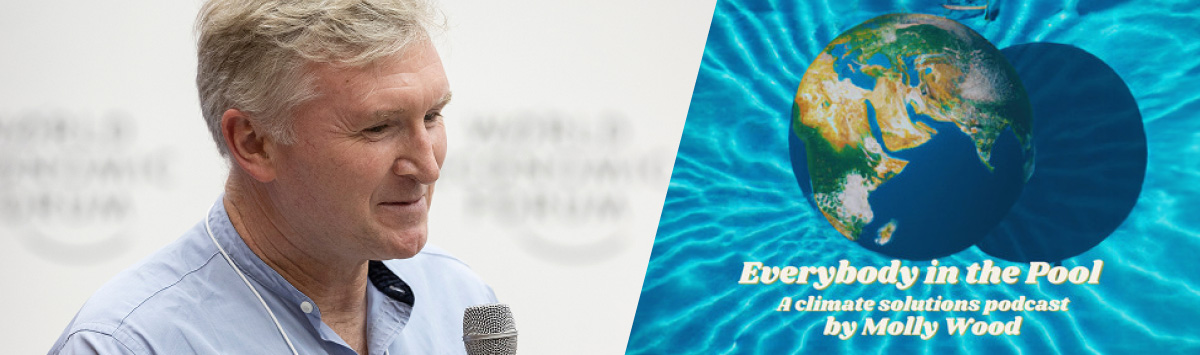
Morphosis Partner Niall Murphy joined Molly Wood on Episode 123 of Everybody in the Pool to explore why adaptation must not be a predominantly public-sector responsibility, but a functioning market that mobilises private capital at scale. Listen to the full podcast here. Today, roughly 90% of adaptation finance comes from public sources. Yet physical climate risks are expanding faster than public budgets can absorb. Without private sector participation, the adaptation gap will continue to widen.
In the conversation, Niall and Molly explore why adaptation should be understood as economic resilience, where commercially viable adaptation opportunities are already emerging, and how private capital must play a central role in building resilience.
Listen to the full podcast here:
Molly Wood: Welcome to Everybody in the Pool, the podcast where we dive deep into the innovative solutions and the brilliant minds who are tackling the climate crisis head-on. I'm Molly Wood.
This week, climate adaptation is suddenly everywhere as the impacts of climate change hit the world all at once. Insurers are freaking out, developing countries are freaking out, financial institutions are freaking out, supply chains are breaking down, food insecurity is increasing as changing weather impacts crops, and water is vanishing in some places while overwhelming others. The world needs way more solutions and way more money for those solutions.
So today, we have a conversation we've actually been building toward for quite a while: What if we stopped treating adaptation as a funding gap and started seeing it as an investment opportunity? Let's do that.
Niall Murphy: I'm Niall Murphy. I'm co-founder and managing partner at an investment business called Morphosis. We are entirely focused on climate adaptation solutions, and I'm coming to you from Geneva, Switzerland.
Molly Wood: People who have been following my work for a while will know that adaptation is near and dear to my heart—that was my initial approach to covering climate. Give us a little bit of context about the adaptation conversation, how it's been a bit slow to start, where we are now, and why there's so much more interest in it lately.
Niall Murphy: Well, I guess we are dealing with the reality that we're now actually living in a world beyond 1.5 degrees. Certainly, my perception is that for a long time, we were operating under the impression that we could bend the curve and keep ourselves under 1.5. We had a narrative that we would remain safe in a "business as usual" world, assuming we could keep temperatures below 1.5 degrees above pre-industrial levels.
That hasn't happened. Arguably—and this is probably another conversation—given the fact that we created that safety margin, we probably guaranteed that we wouldn't stay within it. I'll come back to that. We have moved beyond that, and therefore, there's an increasing realization that the world is, in fact, changing and that those changes are not transient. We had better get good at living in the world as it's going to be; hence, adaptation becomes the thematic conversation in that context.
Molly Wood: There has been, for decades, a sort of controversy about talking about adaptation versus mitigation. I want to say upfront that my opinion is that we can and have to do both. But it's been interesting to watch. Initially, I think it was important to do both because the climate was changing even with relatively small amounts of warming. Now, there does seem to be a conversation about adaptation that feels to me a little bit like a retreat from mitigation. Do you think that's happening, or do you think it's more that there's a focus on both?
Niall Murphy: I think there's an increasing focus on both. Obviously, depending on where you are in the world, the tone of the mitigation conversation is a little different. But if we measure mitigation in emissions per capita and green kilowatt-hours commissioned, we generally see positive progress around the world, with one notable major economy exception.
Molly Wood: That's very gentle of you, Niall. He means us, you guys. He means the US.
Niall Murphy: At the same time, we see a pretty dramatic acceleration in climate impact. We can look at that through insured losses. Right now, the growth curve—depending on the country—is somewhere between 10% and 20% per annum in growth of insured losses from climate. I mean, that's a return curve I would like to have on an investment.
I think that is accelerating the realization that we're in an environment of effect, and therefore adaptation accelerates as an interest point. I agree with you that they are, in fact, two sides of the same coin. Mitigation is a form of adaptation, and adaptation is what we need to do while the gap of mitigation, emission, and change remains open.
I think one can argue, particularly when we look at the declining cost curve per kilowatt-hour in green electrons, that the boat has now pushed out; the inevitable transition is underway, and it's really a policy question as to how fast we can make that adoption happen. In the adaptation context, the boat is definitely not pushed out. We're facing a lot of headwinds from dysfunctional policy, which means we do not have a standard framework for accelerating the adoption of adaptation. We need to do real work there.
Molly Wood: Right. Which is exactly what you are trying to do, because among the gaps, there are certainly huge policy gaps, but there's also a very large and long-standing investment gap, right? And that's what you're trying to close.
Niall Murphy: That is correct. That is very much what we're trying to close. But I think if we look at the articulation around adaptation, it's really dominated by the expression of need. When you see a discussion of adaptation, it's framed as a funding gap or a need for X amount of dollars to meet an impact that's arising.
From our perspective, we would argue that this is an unhelpful characterization of the problem. Circa 90% of dollars going into labeled adaptation investments have been public funds. Obviously, it's good that we're deploying public funds, but those public funds cannot scale to the size of the adaptation problem set that exists today, let alone tomorrow.
As impacts accelerate, those public dollars are under even more allocation pressure. You can just glance at the debt-to-GDP ratios in OECD nations; those ratios are going the wrong way, moving upwards from 120%. The most challenged economies from a climate impact point of view tend to be the most challenged from a debt point of view as well, and therefore under the most fiscal pressure.
So, I think we have to turn this narrative around quite significantly and not talk about need, but talk about demand. If we look at it from a demand-side point of view and say changes are occurring that are systemic—well, actually, wearing the hat of an investor, those are emerging demand markets. Those are, therefore, emerging investment and innovation opportunities.
I know it can sound slightly perverse to talk about "opportunity" in the context of climate impacts, but you're sitting in a valley where we tend to frame disruption as opportunity in the technology world. That's how we have to start looking at climate. Not because that's "spin," but because it's actually a necessary way to understand the investability of the situation. When big changes happen, there are obviously negative impacts, but greenfield markets also get created. That's certainly how we see it.
From a capital stakeholder's point of view, every asset and every economy in the world is climate-risk exposed. We think the right framing here is to look at adaptation as a qualitative characteristic of how secure an investment is. As we see the accelerating impact of climate, we think more and more investors are going to be rating their investments within an adaptation context. They will move toward assets, enterprises, or economies that demonstrate good adaptation capability, because that's simply a more sensible way to both protect and access value.
Molly Wood: Right. I have certainly had conversations about this central tension—saying that really bad things are going to happen due to an amount of warming that we could have prevented. Certainly, over the next 10 years minimum, there's a lot of certainty about what is going to happen. My friend J. Koo calls this the "unavoidable opportunity."
It feels important, in terms of getting that money moving, to say, "Okay, we've previously talked about adaptation as a public investment in hardening—sea walls and infrastructure—that are usually a public investment. Or we have said it's only about risk." Now we're saying we live in a changed climate, which means we live in a climate economy. This means a lot of new solutions will have to be created and funded, and there's an opportunity to make money there. Frankly, that's an incentive to create those new solutions.
Niall Murphy: Right. We put forward a concept which we call the "adaptation economy," which is to take the view that adaptation is a whole-economy issue. It affects all aspects of human well-being, economic well-being, the financial integrity of an economy, and so on. So, it's not a department; it's a transversal lens.
Molly Wood: And in fact, you just presented this framework at Davos recently?
Niall Murphy: That is correct. We have now presented a first pass at being able to quantitatively assess that. What is the state of well-being of different countries in terms of their adaptation economy?
The framing here—to pick up on your point about resilience—is that adaptation is really about a systemic transformation to a circumstance where you are able to move with the changes. I would argue that resilience is about fortifying an existing way of doing things to keep it going. I build a sea wall, I'm preventing some flooding, and I can maybe still live here.
But if we're talking about, for example, a complete change in precipitation patterns in a country where rain happens at different times and in different quantities, that is not something you can build "resilience" to. Your environment has fundamentally changed. How do you systemically transform yourself in response to that change and recognize that the change is in motion? It's not static. Rainfall patterns haven't changed once, only to never change again; they're going to keep changing.
The adaptation economy and the concept of transformative adaptation are really about a deep fitness—a capacity to move with those changes. What are the new types of agricultural processes? What are the new seed varieties? What are you actually going to plant next year versus what you were planting last year because of those precipitation patterns? How are the supply chains that you are feeding into, or that you are fed from, affected by that overall change? That's the perspective we've got to start to take.
Molly Wood: Time for a quick break. There's a lot more in the Morphosis adaptation framework. Among other things, I learned that according to that framework, Portugal is in a great position—culturally and in terms of policy—to embrace adaptation technologies. I'll have a link to the Adaptation Economy Index in the newsletter this week. But when we come back, more on how Morphosis is finding opportunities and aggregating funding for maximum impact.
Welcome back to Everybody in the Pool. We're talking with Niall Murphy of Morphosis Solutions. Boy, I can dig into the systemic part of this for a long time, but let's go back to the money. I want to hear more about Morphosis and your approach to this financing, because it's not as simple as setting up a standard investment fund. You're really trying to create a new mechanism—or perhaps a repackaging of existing financial mechanisms. Give us the details.
Niall Murphy: Well, first, it is an investment business, and we are operating transversely; adaptation is a transversal vertical. On the one hand, one is dealing with water technologies; on the other, agricultural technologies or nature's infrastructure.
We are not a fund. We are creating special-purpose vehicles that undertake investments in these different categories. We can bring together both different types of capital and expert partner investors that are topic-specific to work with a particular investment.
When we talk about adaptation solutions, we're generally talking about technology in the broadest possible sense. A technology might be biotechnology or a financial innovation—a fintech mechanic, for example. That might exist in one geography, but the optimal early-adopter markets for its application might be in a completely different geography. Climate effects are manifesting at different rates around the world, so one has to put together financial structures that are deploying in one market while perhaps funding the technology risk in another.
In some of those instances, there's a need for blended finance or public-private partnership structures. I believe that generally, public funding shouldn't really be taking technology risk—that's what technology venture investments or private capital is for. Blended financing mechanisms work well in deployment circumstances where you're also trying to align with public policy or mitigate political risk factors.
We've created a platform which engages that complexity. We try to find good mappings between innovative solutions that are viable today and selected markets where viable operating conditions exist. Obviously, as climate changes move forward, the number of markets with the need for that kind of solution is going to expand, creating a massive growth opportunity. We're very focused on IP-led technology solutions—hardware, software, or financial innovation—rather than physical infrastructure assets like a mangrove swamp, although those are also very relevant adaptation investments.
Molly Wood: One of the concerns about adaptation funding is that public funding has really lagged, and private funding has also lagged. It sounds like you're saying a way to have maximum impact is to aggregate funders so that you're deploying with maximum power instead of little tiny shots at a time.
Niall Murphy: Yes, and I think one has to be very prudent about where commercial viability exists. You have to align a viable solution with a market where there is a clear demand curve and other conditions that make that solution a commercially sensible and profitable investment.
Molly Wood: Right. You're not in the moonshot game. It's fine that others are, but you are in the "get things done now" game.
Niall Murphy: That's right—and in the commercial returns game. Public finance and philanthropic finance cannot scale to the size of the demand set we have. We have to build profitable, scalable solutions that are affordable to users and provide a direct return to investors.
If we can do that, and have the right policy context to help create markets for those solutions, then we're building an adaptation economy that is attractive to private capital and delivering results. I want to emphasize that this is not about subsidy. Subsidy is just another form of public funding. It's about creating conducive policy or regulatory conditions so that a solution can get off the ground.
And the solutions themselves must be climate-adaptive. There's no point in deploying something that solves an adaptation problem but is going to fail when the temperature goes up half a degree, or whose supply chains are going to seize up. That's how we think the problem is ultimately going to get addressed.
Molly Wood: What is the Morphosis role? Are you identifying the investment opportunities and then aggregating, or are people bringing opportunities to you? Where do you sit in the web?
Niall Murphy: We are an investment manager. We identify solutions that we think are attractive and bring those toward capital providers in our network. Obviously, we are being approached by solution providers as well, and by capital allocators who want to engage but haven't previously had the mechanism to identify, qualify, and determine how to apply them.
We also believe this requires active, applied investment engagement. My background is not originally as a professional investor, but as a professional operator. I've been a founder and CEO of a number of technology companies that I've built and sold. When I look at the challenges facing solution businesses in the adaptation context, they have the normal growth challenges of young businesses, but they are also facing mispriced climate risk and dysfunctional policies.
To succeed, they need to map themselves into the right markets and construct the right execution strategies. We can bring insight on markets where we think policy conditions will become highly conducive, and we can bring some "gray hair"—or wisdom—on execution and scaling up.
Molly Wood: Wisdom is the word.
Niall Murphy: Wisdom, there we go. Those elements help businesses be successful.
Molly Wood: How has this been received so far? Coming out of the most recent COPs, there was a lot more conversation about adaptation and a recognition that the climate has changed. How have you been received at places like Davos?
Niall Murphy: The keyword "adaptation" has rapidly accelerated in use over the last 12 to 18 months. Certainly, in our experience at Davos last week, we are no longer asking whether we should be adapting or mitigating; it's a highly integrated conversation.
What's also interesting is the active engagement from large institutional financial players, particularly from the insurance sector and the investment banking world. They are concerned about the financing of assets and supply chains. They are seeing the "de-insurance" of certain assets, making them uninvestable and unfinanceable. The institutional finance community is very much engaging.
Molly Wood: You heard me chuckle there over the word "insurers," and it was a very dark chuckle.
Niall Murphy: Because that is the tipping point the adaptation economy has been waiting for. The point at which countries, cities, or supply chains become uninsurable creates a massive ripple effect through financial institutions that makes this truly unavoidable. And that is happening now.
I'm talking about the commercial banks that are financing commercial assets and supply chains. They are now very actively engaged because the knock-on effects of systemic risks are very clear. The narrative has historically been dominated by a sense of "need" and an assumption that financing must be concessionary or philanthropic. The commercial finance world rejects that; that's simply not their business model. They've been looking for a frame to have a conversation about how to create investable markets for adaptation, and we've seen a very strong response to our approach.
When we rolled out a pilot quantification of this at Davos, we saw a great response. To build institutional finance products, you need ratings, assessments, and indexes. You need standardization of terminology to compare asset A and asset B.
Molly Wood: It's wild to think that we are at that level of basics with this economy—that we are building that vocabulary in real time.
Niall Murphy: Well, the collective "we" is. The metrics question is a whole other hour, so I won't go there immediately.
Molly Wood: But can you give more examples of the types of commercially scalable solutions that are available out there?
Niall Murphy: A business that I think is incredibly exciting—which we're not invested in right now—is an organic polymer business. It's a chemistry company innovating polymers that are super effective at absorbing and filtering solar radiation.
This is used in simple use cases like the sheeting over greenhouses. It reduces the temperature inside the greenhouse significantly and filters light spectra so you can grow plants more effectively. In a heating environment, you want semi-controlled agricultural situations where you can grow crops even though it's getting hotter outside.
The same polymer can be used as a coating on a window to reduce solar penetration into a commercial building. What's also great is that the business model is not dependent upon a centralized manufacturing capability. The "recipe" can be distributed around the world. That's important because we're going to see more fracturing of supply chains. Business models dependent upon shipping physical stuff across the world are increasingly vulnerable.
Molly Wood: I'm going to get their name from you afterward; I would love to have them on the show.
Niall Murphy: It's a profitable, viable business today. People assume these businesses aren't necessarily viable, but that's simply not true.
Other examples include micro-scale desalination—not for a whole city, but for a single industrial facility or a small community. There are a couple of great solutions meeting that need today, but they also need a supportive policy context. In most countries, producing and distributing potable water is a centralized mandate that only public authorities can undertake. It is generally not legal for an independent party to produce their own water and share it.
With electricity, we solved this with the concept of a feed-in tariff. I can put solar panels on my roof and feed power back into the grid. We're decentralizing the power grid and creating an economic model that facilitates that. That decentralized market model generally doesn't exist with water.
Molly Wood: That's fascinating.
Niall Murphy: And yet water is one of the biggest areas of adaptation. Some estimates suggest a 40% water gap by the end of this decade, driven significantly by changing precipitation patterns. We've got to find innovations that can produce water at a dollar per cubic meter or less. But if they can't execute because they can't operate legally in a commercial market environment, then we're shooting ourselves in the foot. That's where policy and innovation need to work together.
Molly Wood: Perfect. Niall, thanks so much for the time today. I appreciate it.
Niall Murphy: Thank you, Molly.
%201.svg)